
Composite vs Cedar Fence in Vancouver: Which Lasts Longer in Rain (and Works on Slopes)?
TL;DR: In Vancouver’s rainy climate, composite fencing typically lasts longer than cedar because it doesn’t rot and needs far less maintenance. Cedar can still last well here—but only if you stay on top of staining/sealing and board replacement.
Spring Promo: 20% off for a limited time — call/text (778) 318-8578 for a quote.
Quick facts for Vancouver homeowners
- Biggest “rain problem”: wood rot + fast algae/film buildup in shaded yards.
- Composite’s advantage: no rot, no yearly staining, stays straighter when installed correctly.
- Cedar’s advantage: lower upfront in many cases, classic look for character homes.
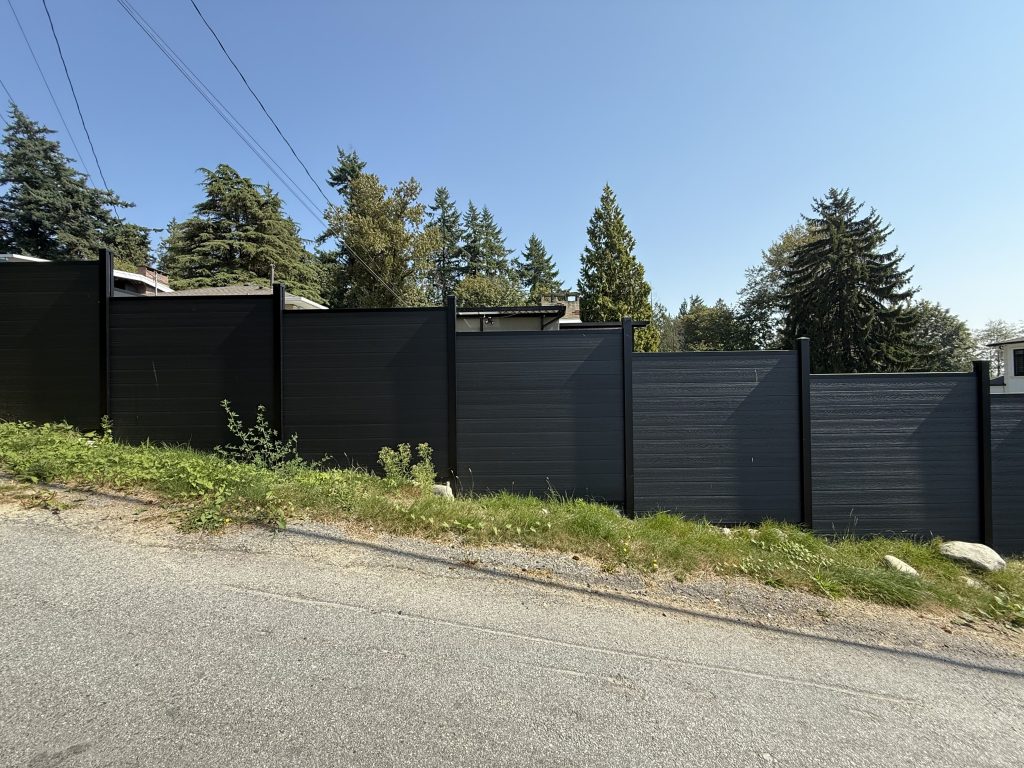
- Sloped yards: yes—composite can be installed on slopes using stepped or racked layouts.
- Best timing: most installs go smoother in drier months (and we also build year-round when conditions allow).
What is composite fencing (and how is it different from cedar)?
Composite fencing in Vancouver typically uses WPC (wood-plastic composite) boards paired with aluminum posts/frames. The goal is simple: you get the “finished” look of wood without the repeated stain/repair cycle that Vancouver rain forces on most cedar fences.
Cedar fencing, by contrast, is real wood—beautiful, but vulnerable to moisture cycling, surface checking, and rot if water sits in joints, post bases, or shaded areas.
Pros and cons in Vancouver rain
Composite fence pros
- Rot resistant: boards don’t decay the way cedar can in constant moisture.
- Low maintenance: typically a rinse + light wash is enough; see our rainy-season care tips in cleaning composite fencing after a rainy season.
- Better dimensional stability: seasonal movement is normal, but warping/cracking is usually an install/framing problem; details in composite fencing movement in BC weather.
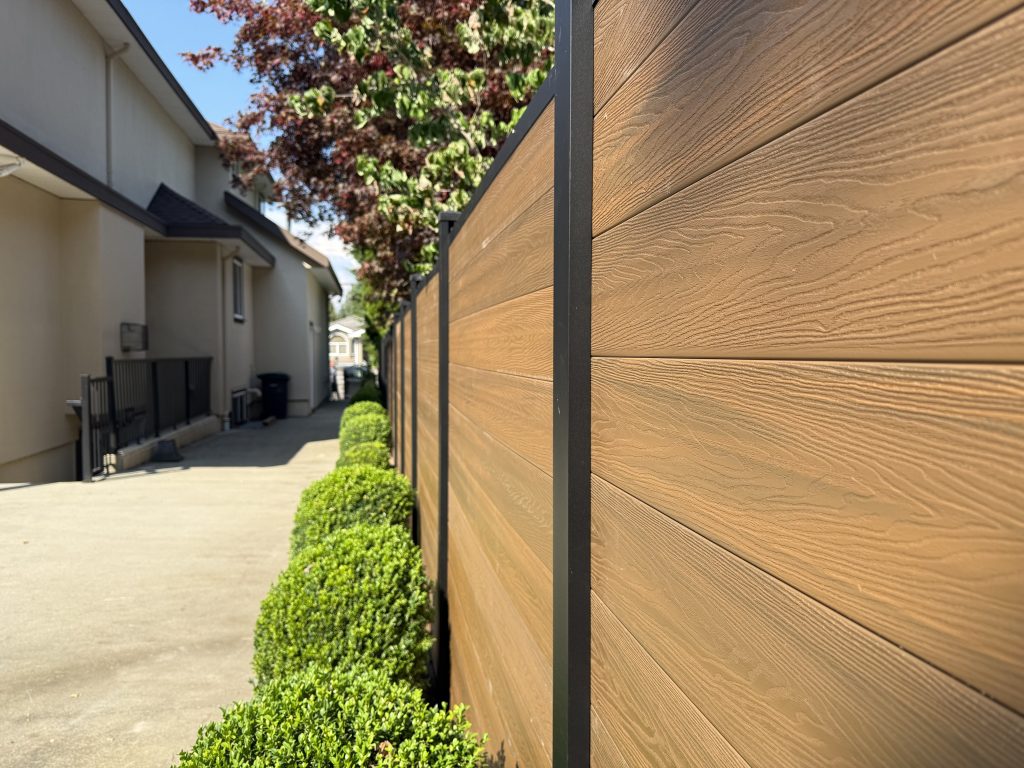
- Modern curb appeal: especially popular for newer builds, duplexes, and laneway lots.
Composite fence cons
- Higher upfront cost: especially once you add gates, demo, slope steps, and tight access.
- Install quality matters more: poor post alignment shows faster on long “straight line” modern fences.
Cedar fence pros
- Classic look: great fit for heritage/character styles in many Vancouver neighbourhoods.
- Often cheaper upfront: depending on cedar grade, design, and site access.
- Easy to modify: simple repairs and board swaps (if you keep up with maintenance).
Cedar fence cons
- Maintenance is not optional here: wet seasons accelerate wear if staining/sealing slips.
- Rot risk at the “usual failure points”: post bases, horizontal rails, and any trapped moisture zones.
- Appearance drifts over time: without regular upkeep, cedar fades, checks, and can cup/warp.
So… which lasts longer in Vancouver rain?
For most homeowners, composite lasts longer with less effort because it avoids the #1 failure mode in this region: rot. Cedar can still be a solid fence in Vancouver, but you’re buying into an upkeep plan—especially on shaded lots, north-facing runs, and tight side yards where airflow is poor.
Here’s the real-world way to think about it:
cedar can last “a long time” only when you treat maintenance like a schedule, not a someday project.
If you’d like the practical breakdown of what maintenance actually costs over time, see
cedar fence maintenance costs in Vancouver.
Composite also handles Vancouver’s “wet + organic film” problem better. If your yard is shaded and stays damp, algae and green buildup can show on any fence surface—composite is simply easier to wash. If this is already your issue, the prevention checklist in
preventing green algae on composite fences will save you a lot of frustration.
Cost comparison (with honest Vancouver assumptions)
Pricing swings wildly in Metro Vancouver because access, slope steps, disposal, gates, and retaining interfaces do the most damage to “per-foot” estimates.
For planning, our install ranges are:
- Composite (most real homeowner projects): typically $120–$220 per linear foot installed once you include real site conditions, finish details, and gates — see composite fence supplier Vancouver pricing assumptions. MapleStar runs $60–$80 per linear foot installed — panels come factory-direct rather than through a distributor.
- Composite (simple straight runs during promo periods): some straightforward installs can price closer to an entry range when conditions are favourable — details often show up on our WPC fence Vancouver and composite fence installers Vancouver pages.
- Cedar (installed): commonly ranges from budget to premium depending on grade and design; many local quotes land in a broad “middle band,” and maintenance is the hidden long-term cost.
Fast way to budget your own yard: measure total fence length, count gates, note slope/steps, and identify any tight access (stairs, narrow side yards, laneways). Then we can price it properly during an on-site review.
Can you install composite fencing on a slope in Metro Vancouver?
Yes. In fact, sloped yards are one of the most common reasons people switch to composite—because a properly framed composite system holds straight lines and clean reveals better than many wood builds once the grade starts changing.
We handle slopes in two main ways:
1) Stepped installation (most common)
The fence “steps” down in level sections. This looks clean and modern, and it works especially well when you mix panel heights in the design. If your lot drops toward a lane or greenbelt, stepped sections using composite panels in different heights can keep privacy where you need it while staying visually consistent.
2) Racked/raked installation (follows the slope)
The fence line angles to match the grade change. This can look smoother on gentle slopes, but it requires careful layout so gaps don’t look sloppy and gate clearances still work.
On steep slopes, we often combine racking + stepping depending on the run.
Slope installs also tend to need better planning around posts and foundations. If you’re doing a supply-only build, start with DIY composite fence panels Vancouver (step-by-step) so you don’t get surprised by post depth, layout, or hardware needs.
Composite vs cedar in rain: side-by-side comparison
| Factor | Composite (WPC) | Cedar |
|---|---|---|
| Rain + moisture | Doesn’t rot; easier to wash | Can rot if water sits; needs stain/seal cycles |
| Maintenance | Rinse/wash as needed | Stain/seal + periodic board/rail replacement |
| Looks over time | More consistent finish | Natural weathering unless maintained |
| Slopes | Excellent with stepped/racked layout | Works, but warping/uneven gaps can show faster |
| Upfront cost | Higher for most builds | Often lower, depends on grade/design |
If you’re also comparing materials beyond cedar, the breakdown in vinyl vs composite fence Vancouver helps you avoid “apples to oranges” quotes.
Best season to build a fence in Metro Vancouver
Dry months usually mean faster digging, cleaner concrete work, and fewer delays—but we install year-round when conditions allow.
If you’re choosing timing around landscaping, drainage work, or a renovation schedule, this guide on
the best season to build a fence in Metro Vancouver lays out what actually changes by month (and what doesn’t).
DIY vs hiring a pro (Vancouver reality check)
DIY is reasonable when the run is short, mostly flat, and you’re comfortable setting posts straight and square.
Hiring a pro is usually the smarter move when you have slopes/steps, tight access, retaining-wall interfaces, multiple corners, or gates that must swing cleanly year-round.
If you want a crew that does this every day (not “sometimes”), start with fence contractors in Vancouver for composite fences & gates.
For real examples of layouts, finishes, and colourways, browse our Metro Vancouver fence projects gallery,
including a recent composite fence project in Maple Ridge.
Safety & compliance notes (keep this simple)
- Confirm property lines: a “nice fence” is not worth a lot-line dispute.
- Know your local fence rules: front/side/rear heights can differ by municipality and corner visibility rules matter.
- Call before you dig: underground utilities are real in Metro Vancouver (especially older neighbourhoods and laneways).
For homeowners who want the official guidance, the City of Vancouver fence/wall page and BC utility locate resources are worth reviewing before posts go in.
FAQs (PAA-style)
1) Does composite fencing rot or swell in Vancouver rain?
Quality composite boards don’t rot like wood. Some seasonal expansion/contraction is normal; correct post framing and clearances prevent the “wavy fence” look.
2) Does cedar always fail fast in Vancouver?
No—cedar can last well here, but it’s maintenance-dependent. If you miss stain/seal cycles or trap moisture at the base, it will age much faster.
3) What lasts longer: composite or cedar?
For most homeowners, composite lasts longer with less upkeep because rot is off the table. Cedar can be long-lasting, but only with consistent maintenance.
4) Can composite fencing be installed on steep slopes?
Yes. Stepped sections are the most common for steep grade changes, and racked layouts can work on gentler slopes. The right approach depends on privacy needs and how the yard drops.
5) Is composite fencing worth it compared to cedar in rainy Vancouver?
Often yes—especially if you’re tired of staining/repairs. If you want the simple decision framework, see composite vs cedar: is it worth it in Vancouver rain?
6) Will composite fencing get green algae too?
It can in shaded, damp areas—but it’s easier to wash than wood, and prevention is mostly airflow + keeping soil/vegetation off the boards.
7) What’s the best fence choice for tight side yards in Vancouver?
Composite is a strong choice because it holds straight lines, doesn’t need repainting, and handles shade better—especially when you design for drainage and access.
8) How do I get an accurate fence quote in Metro Vancouver?
Have your rough length, gate count, and photos ready, and note slope/steps and access constraints. We confirm final numbers after an on-site check.
Get a quote (Spring 20% off)
If you want a fence that stays straight through rain, handles slopes cleanly, and doesn’t demand constant upkeep, we’ll quote it clearly and build it properly.
- Call/Text: (778) 318-8578
- Email: info@maplestarfences.ca
- Request a quote: Contact MapleStar Fencing
- Reviews/Listing:
MapleStar Fencing on Google Maps
Service area: Vancouver, Burnaby, Richmond, Surrey, Coquitlam, Port Coquitlam, Port Moody, New Westminster, Delta, Langley, Maple Ridge, Pitt Meadows, North Vancouver, West Vancouver, White Rock — and more across Metro Vancouver.
