
Maximizing Profits on Surrey Subdivisions: The Builder’s Secret to Faster Fence Installs
TL;DR: On Surrey subdivision projects, fencing profit is usually lost in labour drag, weather delays, finishing steps, and post-handover issues. A modular slide-in composite system can simplify the workflow, reduce site time, and support faster subdivision closeout with lower callback risk.
In Surrey, the money on subdivision fencing is rarely made by picking the cheapest board. It is made by controlling labour, reducing schedule drag, and avoiding the kind of post-completion issues that quietly erode builder margin.
That is why more GCs, developers, and site supers working on townhome clusters, small-lot detached homes, and repeated-lot residential projects are looking harder at modular fence systems instead of treating fencing as just another low-priority wood trade. The old approach may look cheaper on paper, but once you factor in measuring, cutting, fastening, weather interruptions, coating work, and deficiency cleanup, the real installed cost often lands much higher than expected.
For builders working across Fleetwood, Cloverdale, Sullivan, Fraser Heights, Grandview Heights, and South Surrey, the better question is no longer “What is the cheapest fence material?” It is “What system helps me finish faster, coordinate better, and hand over cleaner?” That is exactly where composite fencing Surrey demand is growing.
Why Surrey subdivision fencing quietly drains profit
Most builders already know the pattern. Fence scope looks easy during estimating. Then site conditions turn a simple line item into a coordination problem.
- Labour in Surrey and Metro Vancouver is expensive
- Wood fencing requires more on-site measuring, cutting, and adjustment
- Rain exposure slows production and complicates finishing
- Paint or stain can add another step, another trade, or another return visit
- Warping, shrinkage, loose boards, and inconsistent finish create deficiency risk
On a single backyard, those problems are manageable. On a repeated-lot project, they compound. Multiple lots do not create linear risk. They create multiplied coordination, more supervision time, and more opportunities for closeout delays.
That is why builders researching composite fencing Metro Vancouver are often reacting to one hard truth: slow fencing is expensive fencing.
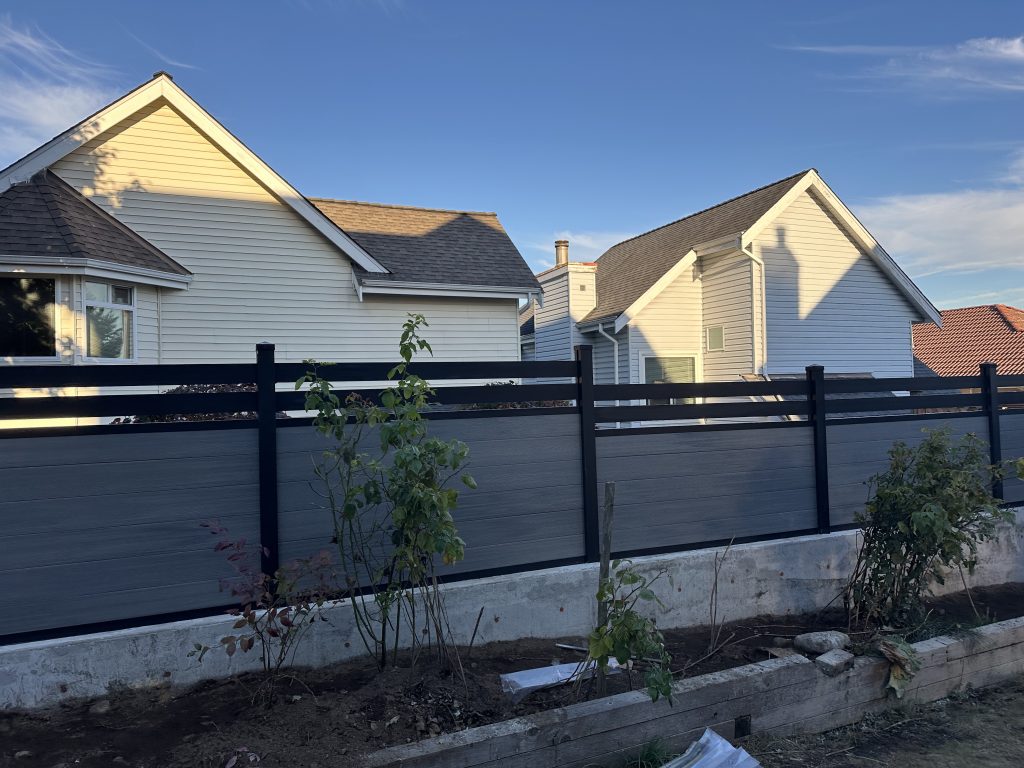
The builder’s secret: stop buying fence scope like a commodity
The biggest mistake on subdivision work is assuming all fence systems install the same way. They do not.
A modular slide-in composite system changes the install sequence. Instead of burning crew time on repeated measuring, trimming inconsistent lumber, handling finishing requirements, and absorbing more weather sensitivity, the workflow becomes more controlled. Posts are set, channels and rails are aligned, and boards slide into place in a repeatable pattern.
That matters because repetition is where subdivision margin is protected. The more predictable the install sequence, the easier it is to plan labour, phase deliveries, and reduce overlap with other exterior trades.
That is also why Maple Star’s commercial value is stronger than a generic “premium fence” pitch. For developers and GCs, the real benefit is not only appearance. It is a cleaner, more standardized system from a composite fence supplier Vancouver that understands builder timelines and staged project work.
A hard-cost example: traditional wood workflow vs modular composite workflow
Here is the commercial logic in plain English. This is an illustrative Surrey subdivision scenario, not a fixed quote or universal install guarantee.
Assume a project with:
- 12 homes
- Approximately 900 linear feet of fence scope
- Rear and side-yard runs
- 2 gates
- Standard access and no unusual retaining-wall complications
| Category | Traditional Wood Fence | Modular Slide-In Composite |
|---|---|---|
| On-site cutting and fitting | High | Lower and more repeatable |
| Weather sensitivity | Higher | Lower for the overall workflow |
| Paint / stain return visit | Often required | Normally not part of the install sequence |
| Visual consistency across many lots | More variable | More controlled |
| Typical repeated-lot workflow duration | Can stretch toward roughly 8–10 working days | Can compress toward roughly 4 working days on a clean, well-sequenced run |
| Post-handover issue exposure | Higher | Lower when properly planned and installed |
The schedule difference is where the margin story changes. If a wood-fence workflow stretches toward 8–10 working days and triggers return visits, you are not only paying for fence labour. You are paying for more supervision time, more sequencing friction, and a slower exterior closeout. A more modular system can shift that math in your favour.
Why faster fence installs improve builder economics
- Lower labour exposure: fewer cutting and finishing steps means fewer on-site labour hours
- Better schedule compression: faster fencing helps complete the exterior package sooner
- Cleaner handoff: a more uniform fence line presents better during walkthroughs and possession
- Reduced callback risk: fewer wood-related issues means fewer small but expensive return trips
- More predictable budgeting: modular supply and install logic is easier to repeat across multiple lots
The most profitable fence system is usually not the one with the lowest sticker price. It is the one with the lowest total installed drag on the job.
Where this works best in Surrey
This approach is especially effective on:
- Townhome subdivisions with repeated lot geometry
- Small-lot detached home developments
- Lane-loaded home clusters
- Perimeter fencing around strata projects
- Spec-home communities where visual consistency matters
On these sites, repetition is the advantage. A more repeatable fence system supports a more repeatable install sequence.
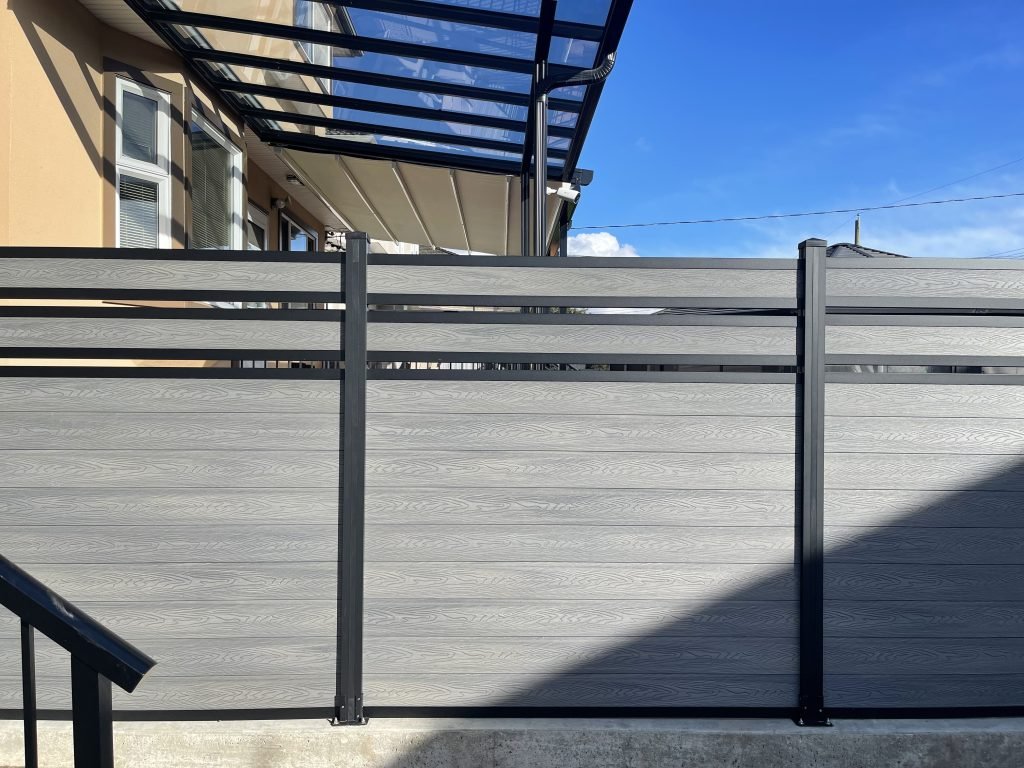
From “zero callbacks” talk to a zero-callback closeout mindset
No serious supplier should promise literal zero callbacks on every project. That is weak sales language. What builders should look for instead is a zero-callback closeout mindset: choose a system and install process designed to reduce the most common post-handover fence issues before they happen.
That means lowering exposure to problems tied to:
- warped or twisted boards
- uneven staining or coating appearance
- inconsistent finish from lot to lot
- sections that already look tired after early weather exposure
- avoidable small deficiencies that pull crews back after handoff
For a developer, every avoided return visit protects time, margin, and reputation.
What builders should ask before choosing a fencing partner
- Can the system be installed in a standardized sequence across repeated lots?
- How much on-site cutting, fitting, or finishing is still required?
- Can the supplier support staged delivery around the build schedule?
- Will the final appearance stay consistent across the project?
- Can the install team work toward a cleaner closeout with lower callback exposure?
If those answers are vague, the cheap price usually stops being cheap very quickly.
This is where reviewing the installation process, builder supply capability, and recent project examples becomes more useful than chasing a low initial number.
Finish choices that work on Surrey subdivision projects
For builder projects, the safest specification is usually a finish that feels modern, neutral, and broadly marketable to future buyers. Matte tones do that better than loud or glossy finishes.
Shadow Grey works well on contemporary developments with black windows, white siding, darker trim, and concrete-heavy landscapes. Walnut Wood works better when the development uses warmer palettes, richer wood tones, or a more upscale natural look.
For builders trying to improve curb appeal without overdesigning, a clean matte composite finish helps the whole project feel more intentional at handoff.
Recommended builder workflow
- Review lot count, linear footage, gate count, and phasing schedule
- Confirm the preferred finish and standard detail package
- Coordinate staged delivery around the build sequence
- Install lot by lot on a repeatable sequence
- Complete a cleaner final walkthrough with lower deficiency exposure
That is the real difference between buying fencing and buying a faster closeout process.
Get the 2026 Surrey Developer & Builder Volume Price List
Request builder-tier pricing, staged delivery planning, and a faster subdivision fence strategy for Surrey repeated-lot projects.
Best for: GCs, developers, site supers, and multi-lot residential builders.
What to send before requesting pricing
- Lot count
- Approximate linear footage
- Gate count
- Project phase or build timeline
- Preferred colour or finish
- Site drawings, takeoff, or progress photos if available
The more complete the information, the more useful the builder pricing conversation becomes.
Why this matters for Surrey builders now
Surrey remains one of the most active areas in Metro Vancouver for repeated-lot residential construction. On these sites, slow fencing is not a side issue. It is a profit leak. Builders who still treat fence scope like a basic afterthought keep absorbing labour inefficiency, more schedule friction, and more post-handover cleanup than they need to.
The builders who protect margin better are the ones who simplify the install system, reduce avoidable steps, and move the exterior package toward cleaner closeout. That is the real secret. Not just a cheaper board. A better workflow.
Related internal reading
- Composite Fencing Surrey
- Composite Fencing Metro Vancouver
- Composite Fence Supplier Vancouver
- Composite Fence Cost Vancouver
- Fence Installation Services
- Recent Fence Projects
- Contact Maple Star Fencing
FAQs
Is composite fencing really faster to install on Surrey subdivision projects?
On repeated-lot projects, a modular slide-in system can be significantly faster than a traditional wood-fence workflow because it reduces cutting, fitting, finishing, and return-visit requirements.
Why do builders lose profit on wood fencing even when the material looks cheaper?
Because labour, weather delays, finishing steps, visual inconsistency, and post-handover issues often push the real installed cost much higher than the original estimate.
Can a modular composite system help reduce callback exposure?
Yes. No system removes every possible issue, but a more controlled and repeatable install process can reduce the kinds of wood-related problems that usually lead to return visits.
What kind of Surrey developments benefit most from this approach?
Townhome clusters, small-lot detached communities, lane-loaded homes, and other repeated-lot residential projects benefit the most because the install sequence is easier to standardize.
Which finish is safer for a modern Surrey subdivision: Walnut Wood or Shadow Grey?
Shadow Grey is usually the safer choice for cooler, more contemporary exterior palettes. Walnut Wood works better when the homes use warmer tones or a more natural upscale look.
What should a builder send to request the 2026 Surrey Developer & Builder Volume Price List?
The most useful starting points are lot count, approximate linear footage, gate count, phasing schedule, and the preferred fence finish or detail package.
