
Composite vs. Vinyl vs. Wood: Which Fence Truly Survives Vancouver’s Wet Climate?
TL;DR: In Vancouver’s rainy, coastal conditions, wood fails most often from moisture-driven rot + warp, vinyl (PVC) avoids rot but can look “plastic” and moves more with temperature, and capped composite (WPC) tends to be the best long-term balance: rot-resistant like vinyl, but typically more rigid, more premium-looking, and more stable when built as a proper post-and-panel system. If you want the “build it once” option, start with composite fence panels Vancouver homeowners are installing across Metro Vancouver.
Call/Text: (778) 318-8578 | Get a quote: Request a Free Estimate | Product options: Composite Panel Sets
Want to see reviews and directions first? MapleStar Fencing on Google Maps
Why Vancouver is a “stress test” for fences
If you’ve lived here long enough, you already know the pattern: months of rain, damp soil that stays saturated, shady side yards, and freeze–thaw pockets in the Fraser Valley and higher elevations.
Vancouver Harbour climate normals show roughly 1,537 mm of precipitation per year—and the wet season is where weak fence systems get exposed.
The material matters, but the system matters more: posts, footings, drainage clearance, and gate structure. That’s why we talk about composite as a full system (posts + channels + boards), not just “a board.”
If you want the local reality version, read: composite fencing BC.
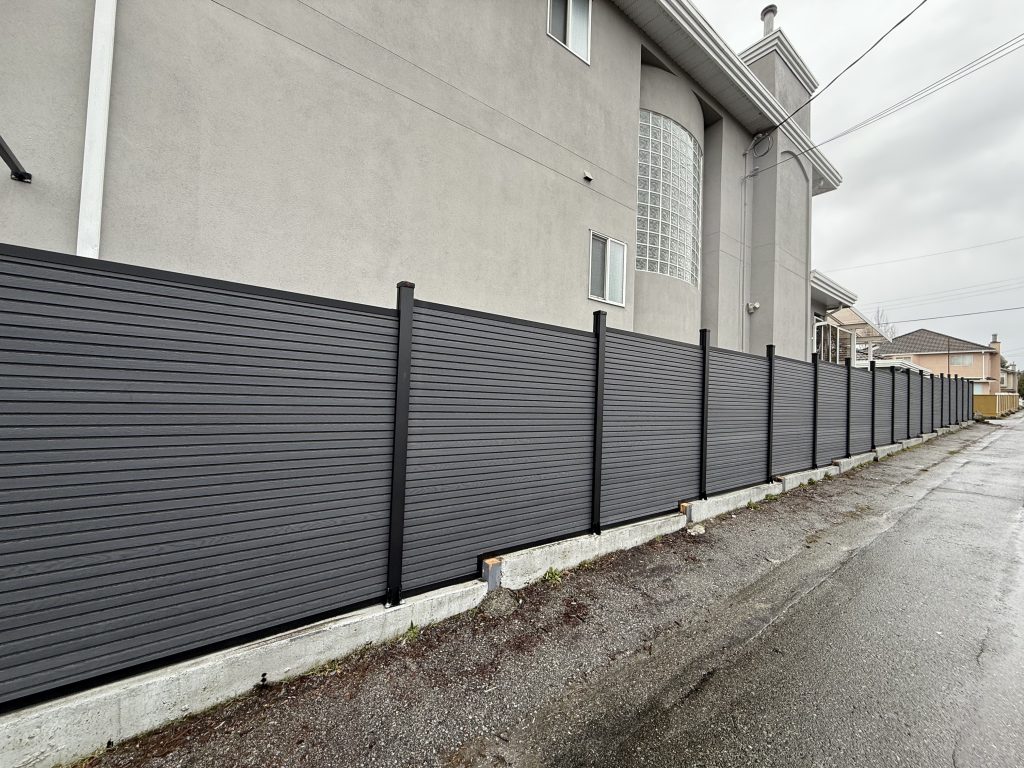 Composite vs. vinyl vs. wood in Vancouver rain: capped composite delivers rot resistance with a richer wood-grain look than ‘plastic’ vinyl.
Quick definitions (so we’re comparing the right things)
- Wood fence (typically cedar here): Natural boards/pickets fastened to rails and posts. Looks great day one; needs ongoing maintenance in wet climates.
- Vinyl fence (PVC): Hollow or cellular PVC posts/rails/pickets, assembled as a system. Rot-proof, low maintenance, but can look “plastic” and requires thermal movement allowances.
- Composite fence (WPC, often capped/co-extruded): A wood-fibre + polymer core, usually with a protective “capstock” outer layer. Designed to reduce water uptake and keep colour/texture more consistent over time.
For the Vancouver-only comparison between two common “no-rot” options, see: vinyl vs composite fence Vancouver.
The data that actually matters (moisture, movement, and weathering)
1) Moisture + rot risk (wood’s #1 enemy)
Wood decay fungi need moisture. Canadian building science guidance commonly points out that wood becomes far more vulnerable to decay as moisture content rises—20% is often cited as a “maximum safe” zone, and conditions around fibre saturation (~25–30% moisture content) are where fungi activity becomes much more feasible. In practical terms: Vancouver’s wet season keeps fence bottoms and shaded sections in the danger zone.
2) Thermal expansion (vinyl’s hidden problem in long runs)
PVC expands and contracts more than most homeowners expect. Rigid PVC’s coefficient of linear thermal expansion is commonly reported around 3.2 × 10⁻⁵ in/in/°F.
That’s why quality vinyl systems require expansion gaps and “floating” details—tight-fitting rails can bow when temperature swings.
Movement math (quick, real-world):
An 8 ft rail is 96 inches. If you see a ~60°F seasonal swing across sun-exposed sections, expansion is roughly:
96 × 0.000032 × 60 ≈ 0.18 inches (about 3/16″).
That doesn’t sound huge—until it has nowhere to go and your panel starts to “smile” or push against fasteners.
3) Composite stability (why capped WPC behaves differently than wood)
Composite isn’t magic—WPC is still a polymer-based product—so it will move with temperature. But the numbers and design intent are different: many WPC products report lower thermal expansion than PVC, and research also notes that increasing wood fibre content can reduce WPC thermal expansion.
On the moisture side, capped/co-extruded WPC designs generally reduce water absorption and thickness swelling compared to uncapped composites.
Example test-style data (ASTM-based reporting) shows WPC water absorption by weight can be well under 1% after 24-hour submersion, with very low thickness swelling—exact values vary by formulation and cap design.
The takeaway for Vancouver: a properly capped composite fence board is engineered to resist the “wet wood cycle” that causes cedar to cup, split, and soften at the bottom edge.
Real-world Vancouver failure modes (what we actually see)
Wood (cedar) — the predictable decline
- Bottom-edge rot: especially where boards touch soil or get constant splashback.
- Warp + twist: repeated wet/dry cycling makes boards cup and fasteners loosen.
- Post lean: saturated soil + shallow/aging footings = wavy lines and gates that won’t latch.
- Maintenance fatigue: staining starts strong for the first few years, then gets skipped… and the fence declines fast.
If you’re weighing the “looks” of cedar vs the long-term reality, this is the Vancouver-specific answer: is a composite fence worth it vs cedar in Vancouver’s rainy climate?
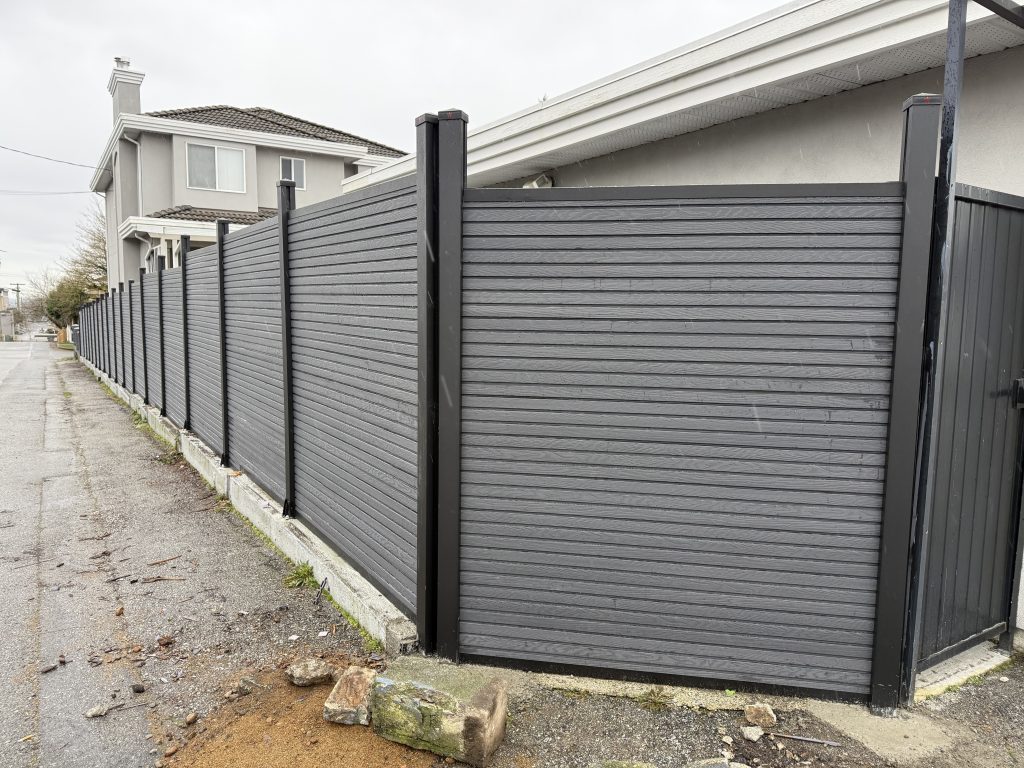 Built for wet seasons: straight posts, proper clearances, and premium embossed composite boards keep this Metro Vancouver privacy fence stable year after year.
Vinyl (PVC) — rot-proof, but not problem-proof
- Thermal movement: long sunny sections need proper expansion allowances, or they can bow/warp.
- “Plastic look”: especially on close-up backyard patios and modern landscaping where texture matters.
- Surface weathering: PVC can weather over time; chalking and surface changes are known outdoor PVC behaviours depending on formulation and exposure.
- Rigidity depends on reinforcement: many vinyl systems rely on inserts/reinforced posts to feel solid in wind.
Composite (capped WPC) — the “system” wins or loses
- Most common failure isn’t the board: it’s poor post alignment, weak gate framing, or wrong clearances at the bottom edge.
- Cheap composite can disappoint: uncapped or low-grade boards can stain more and feel less stable.
- Premium composite looks and feels different: texture matters—this is why we push options like 3D deep embossed composite boards for high-visibility sections.
So… which fence survives best in Vancouver rain?
If you want the most honest answer:
- Best “upfront budget” option: wood (cedar) — but only if you accept maintenance as part of ownership.
- Best “no rot, lowest upkeep” option: vinyl — but you must accept a more synthetic look and ensure the system is installed for thermal movement and wind.
- Best “premium look + wet-climate durability” balance: capped composite — because it avoids wood’s decay cycle, tends to feel more substantial than vinyl, and offers higher-end texture options that look right in modern Vancouver yards.
That’s the niche MapleStar focuses on: composite fencing as a dedicated system, built for Metro Vancouver lots.
Start here: composite privacy fence panels Vancouver.
Installed cost ranges in Metro Vancouver (planning numbers)
Assumptions: 5–6 ft privacy fence, typical residential access, concrete-set posts, includes standard hardware. Exact quotes vary by slope, demo, corners, and gates.
- Wood (cedar) installed: typically $55–$110 / linear ft (widely variable based on grade and build spec).
- Vinyl (PVC) installed: typically $80–$140 / linear ft (depends heavily on reinforcement, post spec, and panel design).
- Composite installed: commonly $60–$80 / linear ft in Vancouver—see our detailed guide:
composite fence cost Vancouver.
Budget tip: if your fence includes gates, treat them as a separate line item. Gates are where “cheap builds” show up first. See:
custom composite fence gates (up to 4 ft).
Pricing disclaimer: Planning ranges only. Final pricing depends on site conditions, access, slope, demolition/disposal, number of gates, and mounting method.
MapleStar’s wet-climate install process (why the system matters)
- Site check + layout: property line, grade changes, and gate locations (the “straightness plan”).
- Rules check: Vancouver has common thresholds (front ~4 ft, side/rear ~6 ft for typical lots), but always confirm your site. See:
Do I need a permit to build a fence in Vancouver? - Utility locates: request locates before digging. (This is non-negotiable.) Use:
BC 1 Call (Homeowners) - Footings + posts: plumb, aligned, and built for long runs (this prevents “wave” lines).
- Composite boards + channels: installed with correct bottom clearance and drainage considerations.
- Gate build-out: reinforced frame + proper clearances so it doesn’t sag after two winters.
- Clean finish: caps, trims, and alignment check along the full run.
If you’re planning around summer backyard season, this matters:
best season to build a fence in Metro Vancouver.
DIY vs Pro (and the risks most people underestimate)
DIY can work for short, straight runs with easy access, no slope, and no gate. The moment you add slope, corners, or a gate, most DIY builds fail on alignment and structure—not materials.
Hire a pro when you need: long runs that must stay straight, tight property lines, slope/retaining interfaces, or a gate that has to feel solid for years.
Biggest risks: digging without locates, building off the true property line, under-building posts, and ignoring thermal movement allowances (especially with vinyl).
Quick facts (Vancouver wet climate fence comparison)
- Vancouver rain reality: ~1,537 mm/year precipitation (Harbour normals)
- Wood rot trigger: sustained high moisture content makes decay likely
- PVC movement: higher thermal expansion, needs expansion-friendly installation details
- Capped composite advantage: engineered moisture resistance + premium texture options
- Most important build detail: posts + footings + gates (material is only half the story)
FAQs (People Also Ask)
1) Does vinyl fencing absorb water or rot?
Vinyl (PVC) doesn’t rot like wood, and it does not absorb moisture the way cedar does. The bigger concern is thermal movement and long-run rigidity depending on reinforcement.
2) Will composite fencing swell in Vancouver rain?
Quality capped composite is designed to resist water absorption and minimize thickness swelling. It won’t behave like cedar boards that cup/soften from wet cycling—provided the fence is installed with proper clearance and drainage considerations.
3) Which looks more “high-end”: composite or vinyl?
Composite generally wins on texture and realism—especially premium options like 3D embossed wood-grain boards. Vinyl can look clean, but close-up it often reads as smooth plastic.
4) What lasts longer in Vancouver: composite or cedar?
In wet coastal yards, composite is often the longer-lasting choice because it avoids the rot + stain cycle that drives cedar failure. Compare here: composite vs cedar in Vancouver rain.
5) Why do some vinyl fences bow or warp?
Often it’s thermal expansion combined with tight-fitting rails or insufficient allowance for movement. Vinyl systems should be installed to accommodate expansion/contraction.
6) How much does a composite fence cost installed in Vancouver?
Most projects budget around $60–$80/lf installed depending on access, slope, corners, demo, and gates. Full breakdown: composite fence cost Vancouver.
7) Do I need a permit for a 6 ft backyard fence in Vancouver?
Many typical detached/duplex lots can build up to ~6 ft on side/rear yard lines without a permit, but confirm your property and conditions. Guide: Vancouver fence permit basics.
8) What should I do before any fence post digging?
Request utility locates. Use BC 1 Call before you dig.
Bottom line: Vancouver’s “best survivor” fence
If you’re being attacked by vinyl marketing, here’s the clean truth:
vinyl is a solid low-maintenance option when installed correctly, but it can look synthetic and it moves more with temperature.
wood is beautiful but demands maintenance and is vulnerable in wet seasons.
capped composite is the best all-around survivor in Vancouver when you want rot resistance and a premium look that matches modern West Coast homes.
If you want a quote with the right spec (posts, gates, and panel options), call/text
(778) 318-8578 or request an estimate here:
https://maplestarfences.ca/contact/.
