
Want to check reviews and directions first? See MapleStar Fencing on Google Maps
Composite fencing (simple definition for strata councils)
Composite fencing uses WPC-style boards (a blend of wood fibres + polymers, often with a protective outer layer) installed into a rigid post/channel system.
The goal is predictable performance in our wet coastal climate: no rot, no staining cycles, and straighter long runs than typical wood.
If you need a quick overview for council members who are new to the material, start here: composite fencing Metro Vancouver
and our strata-specific page: composite fence for strata Vancouver.
Why stratas are replacing wood fences after wet winters
Wood fences rarely “fail politely.” They rot at the bottom edge, twist along long runs, and start leaning once posts shift in saturated soil.
In townhome and condo complexes, that turns into real operational pain:
- Recurring stain/paint projects that owners argue over (timing, colour, contractor choice, cost).
- Emergency repairs after wind events or when boards finally snap.
- Inconsistent appearance because different sections get patched at different times.
- Gate sag and latch problems (the most complained-about “small issue” in strata walkways).
Composite solves the “wet-climate maintenance loop” and also helps councils standardize appearance across the whole community.
For planning, we often recommend building the scope using our
fence replacement checklist for townhouse complexes.
Budgeting 101: what $80–$160/lf usually includes (and what it doesn’t)
The $80–$160 per linear foot range is a practical planning band for strata projects because long, repeatable runs allow better efficiency than one-off residential installs.
The exact number depends on scope clarity.
AGM-ready budget sentence (copy/paste):
“Council proposes replacing the existing failing wood perimeter fencing with a standardized composite fencing system to reduce long-term maintenance, avoid recurring stain cycles, and stabilize the fence line for 15–20+ years. Budget is based on measured linear footage and includes defined alternates for gates, demolition, and slope areas.”
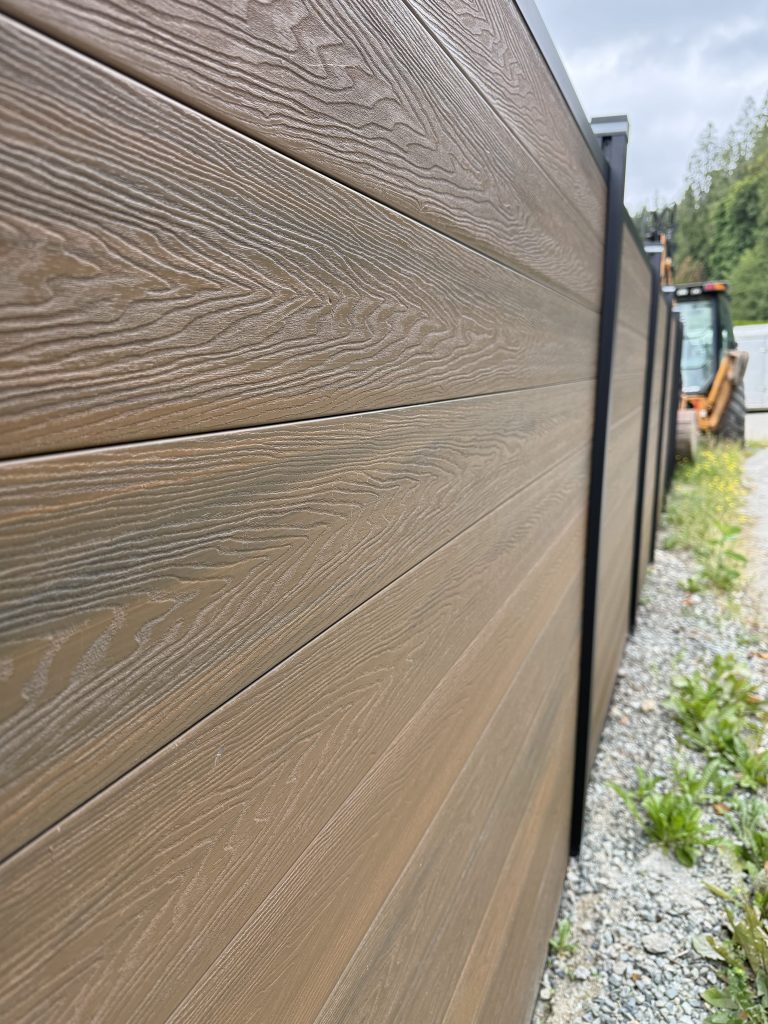 Strata-ready composite fencing: straight long runs, consistent colour, and far less upkeep than wood—ideal for Metro Vancouver perimeter replacements.
Typical strata pricing table (Metro Vancouver planning ranges)
| Scope item | Planning range | Notes |
|---|---|---|
| Standard long-run composite fence | $80–$160 / lf | Best fit for 200+ lf runs, standard height, good access, clean layout. |
| Demo + haul-away of old wood fence | Add-on (site dependent) | Old posts in concrete, tight access, and disposal volume change labour fast. |
| Slope / stepped sections / retaining transitions | Add-on (site dependent) | Measured and priced as a defined “slope allowance.” See composite fencing on a slope in Metro Vancouver. |
| Gates (walkway / utility / wider access) | Quoted per gate | Gates are not “free.” Good ones are engineered. See 2.0mm frame composite gates. |
| Concrete / anchor-base mounting (walkways, pads) | Quoted by condition | Common in townhome complexes. Example: anchor base composite panels. |
Important: These are budget ranges, not a quote. A strata quote should be built on measured linear footage, defined alternates, and a clear scope.
ROI (life-cycle) breakdown: composite vs wood for strata fencing
The reason composite passes AGM votes more easily is simple: councils don’t want to re-fund the same fence every few years.
Here’s a clean way to explain ROI without “sales talk.”
Example ROI model (use your own numbers)
- Fence length: 400 lf perimeter run
- Wood option (installed): lower upfront, but requires periodic stain/repair and earlier replacement
- Composite option (installed): higher upfront, minimal upkeep, longer service life
If your wood fence requires a major stain/repair cycle every few years (plus recurring “patch” labour), the life-cycle cost can exceed composite even if the initial quote looks cheaper.
Composite also reduces “surprise” assessments because the system is designed for wet climates and long runs.
How to present ROI in one line at AGM:
“Composite costs more upfront, but it removes recurring stain cycles and reduces emergency repairs—so total spending over 15–20 years is typically more predictable than wood.”
Note: We can provide a simple life-cycle worksheet with your measured footage and your strata’s historical maintenance costs.
For councils that want additional product comparison context (useful for “why this spec?” questions), see:
Trex vs SimTek vs Cleanline panels in Vancouver.
“Cheaper doesn’t mean lower quality” — how we keep strata pricing competitive
Strata buyers are right to be skeptical: in construction, “cheap” often means corners were cut.
Our approach is different: we stay competitive through efficiency and standardization, not by downgrading the structure.
- Factory-direct staging: Our local supply chain helps keep material availability stable and reduces site downtime. See composite fence supplier Vancouver.
- Repeatable systems: Standard panel kits and posts help long-run fence lines stay consistent. Example post component: two-sided composite fence line post.
- Cleaner scopes: We quote with alternates (demo, slope, gates) so councils don’t get “change-order surprise.”
- Strata scheduling: Phased replacements reduce disruption and make budgeting easier (replace the worst run first, standardize the spec, finish the rest).
If your complex wants a supply-only option (some stratas have in-house maintenance or a preferred GC), we can support that too:
wholesale composite fencing Vancouver.
Step-by-step: how to scope a strata fence replacement for spring AGM approval
- Confirm ownership & responsibility: Is the fence common property or limited common property? Check the strata plan and bylaws before tendering.
- Measure linear footage (LF): Do a simple site walk, mark start/end points, and note gates, corners, and any concrete-mounted sections.
- Choose a standard spec: Height, colour, privacy level (solid vs semi-private), and gate standard. Stratas often standardize on composite privacy fence panels Vancouver for perimeters and semi-private composite fence panels for walkways.
- Identify risk zones: Slopes, retaining walls, tight access, and areas requiring hand-carry. Price these as defined allowances.
- Plan compliance: Confirm municipal height rules (especially corner lots and street-facing sections). If you’re in Vancouver, start here: City of Vancouver fences and walls guidance.
- Utilities & safety: Before any post digging, request locates via BC 1 Call.
- Approval pathway: Decide whether the project is funded via operating/CRF or a special levy and align with voting requirements and meeting timing.
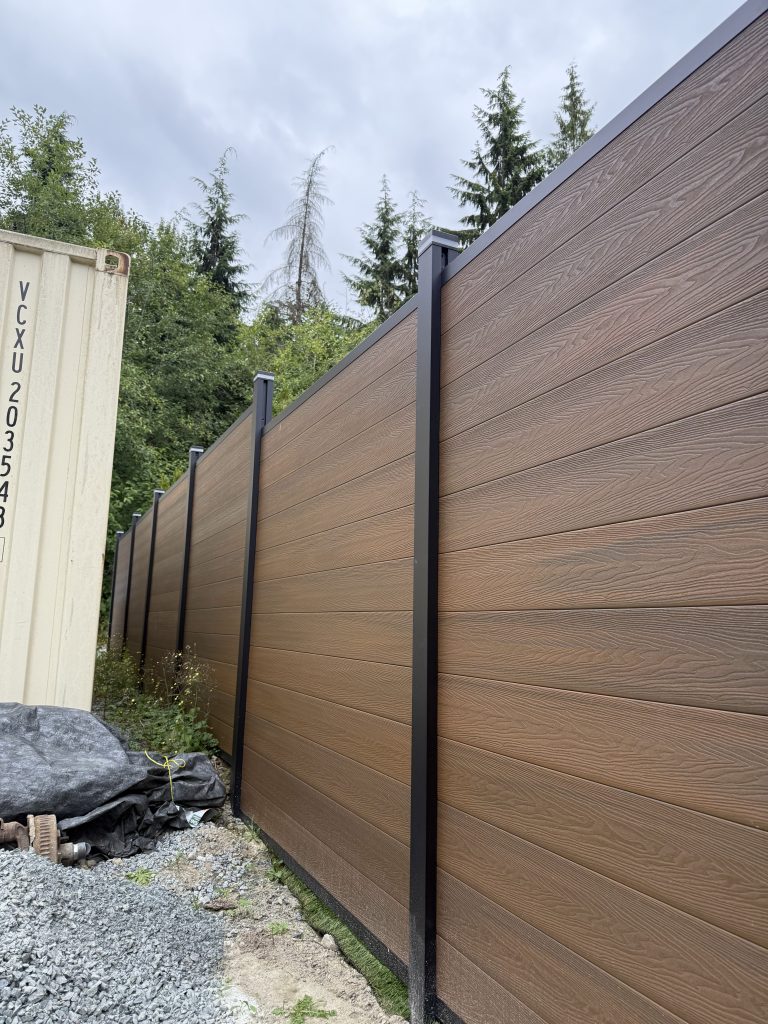 AGM-friendly upgrade: replacing rotting cedar with composite helps councils reduce repeat stain/repair cycles and stabilize long-term fencing budgets
Want a ready-made scope checklist for your property manager package?
Use our townhouse complex fence replacement checklist and send it with your measurement notes.
DIY vs pro (for strata): when “in-house” makes sense and when it’s risky
DIY / in-house maintenance can work when the fence run is short, flat, and non-critical (no gates, no slope, no property line complexity), and the strata already has proven trades supervision.
Hire a professional installer when the project includes long perimeter runs, shared boundaries, multiple corners, gate systems, slopes/retaining transitions, or where appearance must stay uniform across the whole complex.
Big risk to avoid: composite panels will only look as straight as the structure holding them. If posts aren’t perfectly plumb and aligned, the entire run reads “wavy” from the street.
Quick facts (for council packages)
- Budget range (planning): $80–$160/lf for most long-run strata composite fencing
- Best season: spring through early fall for clean installs and predictable scheduling (see best season to build a fence in Metro Vancouver)
- Best ROI driver: removing the stain/repair cycle and reducing emergency repairs
- Approval strategy: define alternates (demo, slope, gates) so owners vote on a clear scope
- Quality signal: engineered gate frames and proper post structure matter more than “brand name boards”
FAQs (Strata Councils & Property Managers)
1) Do we need an owner vote to replace a strata fence?
Usually yes, especially if it’s a major common-property replacement or changes the specification. Your property manager should confirm the exact voting threshold for your strata and funding method.
2) Can we fund fencing through the CRF instead of a special levy?
Many stratas plan major replacements through the CRF when forecasting supports it. If funding isn’t sufficient, councils may consider a special levy route (your manager will confirm the correct process).
3) What’s a clean way to avoid “change orders” after approval?
Quote with defined alternates: (A) base LF, (B) demo/haul-away, (C) slope allowance, (D) gates, (E) anchor-base sections. Owners approve a transparent scope instead of a mystery total.
4) Why does composite pricing vary so much from one complex to another?
Access (hand-carry vs machine access), slope/retaining transitions, demolition complexity, number of gates, and whether sections mount to concrete all change labour.
5) Does composite fencing look “too commercial” for townhomes?
No—most modern composite systems are designed for residential curb appeal. Many stratas choose clean privacy panels for perimeters and semi-private slats for walkways to keep the site feeling open.
6) What’s the #1 failure point on older strata fences?
Posts and gates. Boards are easy to replace; a failing post line turns into a full rebuild. That’s why we treat gate structure as part of the engineering, not an afterthought.
7) Can we replace fences in phases?
Yes, and it’s often the smartest approach. Approve one standardized composite specification, replace the worst run first, and complete remaining sections as budgets allow.
8) Do we need to contact BC 1 Call for fence post digging?
Yes. Fence posts are ground disturbance. Locates reduce safety risks and avoid expensive utility damage.
9) How do we confirm a contractor is legit for strata risk management?
Ask for liability insurance documentation and confirm WorkSafeBC status (clearance letter) as part of your procurement checklist.
Get an AGM-ready strata quote package (built for approvals)
If you send us basic information (approximate LF, photos, and a rough site plan), we’ll return a strata-ready package:
measured scope, defined alternates, timeline, and a clean $80–$160/lf planning narrative that helps owners understand ROI.
Request a Strata Estimate: https://maplestarfences.ca/contact/
Call/Text: (778) 318-8578 •
Email: info@maplestarfences.ca
Service area: Metro Vancouver (Vancouver, Burnaby, Richmond, Surrey, Coquitlam, Port Coquitlam, Port Moody, New Westminster, North/West Vancouver, Delta, Langley).
